

The truth is in your Shadow - Chapter II
Copyright Jerry A Thomas 2026
All choices follow a path. The question is: whose path is it?
Chapter II
18 June 2008
Gangneung Elementary School
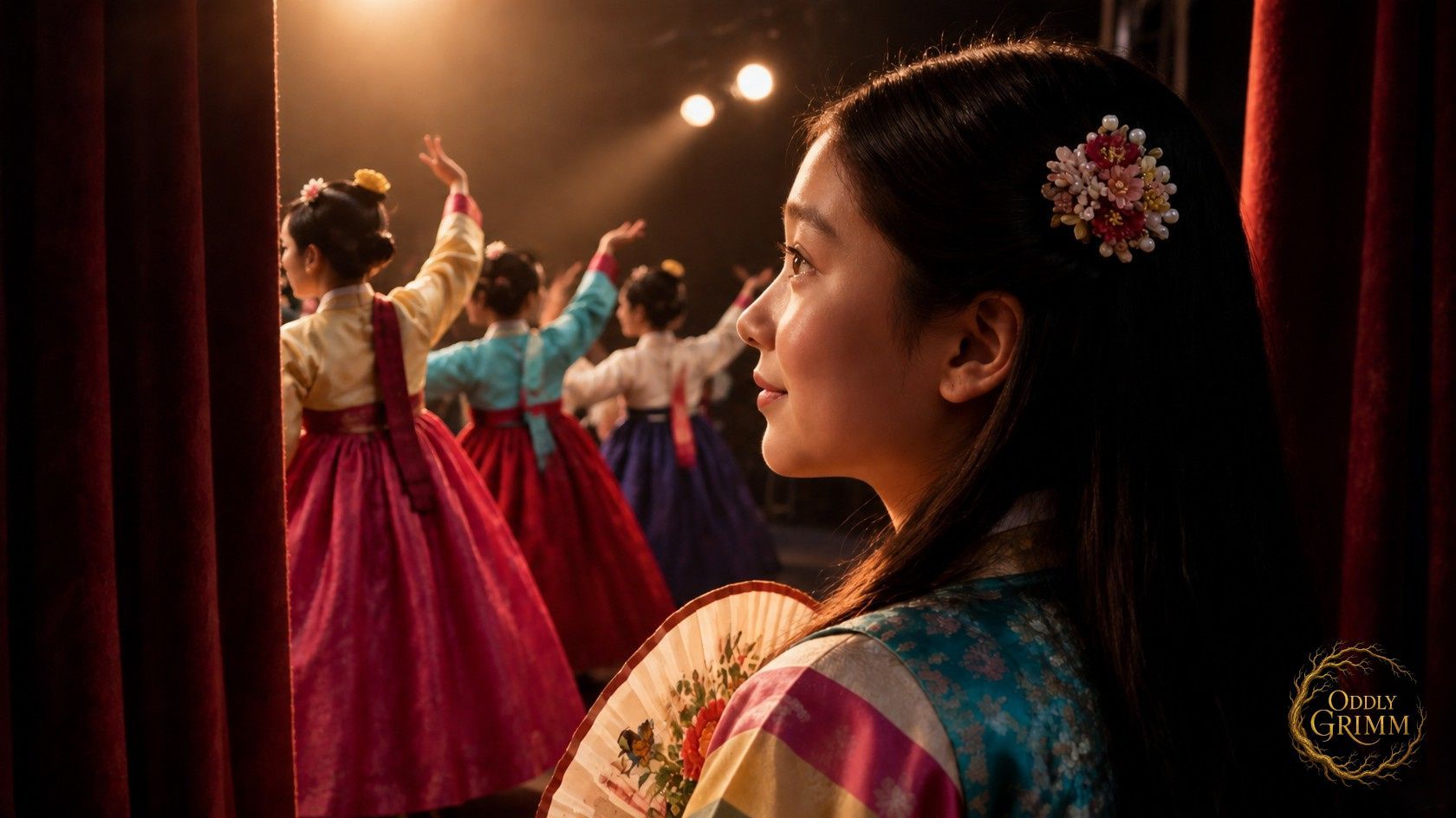
The painted paper fan trembles in Hae-won’s hands with excitement. Behind the heavy stage curtain, twenty-three children wait for their cue. Some whisper amongst themselves, while others fidget with costumes and props. Teachers hurry about making last-minute adjustments. A boy wearing traditional robes repeatedly recites his opening lines beneath his breath and two girls giggle every few moments before remembering they are supposed to be serious. The smell of face paint, varnished wood and freshly ironed costumes fills the cramped waiting area.
Hae-won loves every second of it. She adjusts the sleeves of her hanbok for what feels like the hundredth time and carefully checks that the ribbon at her waist remains tied. Her role is small. Very small. She enters during the second scene, crosses the stage, delivers three lines, then joins a short musical sequence. As it ends, she disappears into the background whilst the principal characters carry the story forwards.
The starring roles have gone elsewhere, and everyone knows why. The son of the school’s largest benefactor plays the noble scholar. The daughter of a local business owner has been given the lead female role. Another boy, whose mother sits on the school’s governing committee, somehow acquires more lines than anyone else.
Hae-won does not mind. At least, she tells herself she does not. To her, what matters is being there, on the stage.
When auditions are announced months earlier, she volunteers before the teacher even finishes explaining the production. The memory of the touring musical still burns brightly inside her. Not a day passes without her imagining herself standing beneath stage lights once again.
A sharp voice interrupts her thoughts.
“Don’t mess up your lines.”
Hae-won turns. One of the older girls stands nearby, arms folded. The expression upon her face suggests she regrets speaking at all.
“I won’t,” Hae-won replies brightly.
The girl nods but she doesn’t leave. Instead, she exchanges a glance with another student. A glance Hae-won has begun noticing more frequently. The whispers follow a moment later, but not low enough that they cannot be heard.
“She always acts like she’s the main character.”
The second girl smirks.
“Even when she isn’t.”
They laugh softly. Hae-won looks down at her paper fan. For a moment she is not entirely sure what she has done wrong. She does not complain about her role or ask for more lines. She certainly does not want someone else’s part but simply likes being there, rehearsing, performing. She likes the feeling that comes from helping a story come alive.
The teacher claps her hands sharply.
“Places, everyone.”
The chatter instantly stops. Beyond the curtain come the muffled sounds of parents taking their seats. Programmes rustle. Chairs creak and voices rise and fall.
Hae-won’s heart quickens and a smile slowly spreads across her face.
The others hear an audience. She hears possibility.
The curtain rises and a hush settles across the assembly hall. For a moment, all Hae-won can hear is the sound of her own breathing. Then the first notes of traditional music drift across the stage and the performance begins. From the wings, she watches the opening scene unfold. The noble scholar delivers his lines with practised confidence. The audience responds politely. Parents smile and cameras flash from the rear of the hall.
Everything proceeds exactly as rehearsed.
Cue follows cue. Line follows line. Nothing goes wrong. Yet nothing feels special either. Not to Hae-won. The production feels like a story waiting to wake up.
Then her moment arrives. One of the teachers standing in the wings points towards the stage and Hae-won nods. The paper fan tightens in her grasp, and she steps into the light.
Immediately the audience disappears, but not physically. Only from her awareness. The rows of parents, teachers and cameras. The bright hall beyond the stage. All of it falls away. Only the performance remains and the world of the story exists.
Her first line leaves her lips with a confidence that surprises even her. The second follows naturally and by the third, she is no longer remembering what she learned during rehearsal. She is simply speaking. Existing within the scene. For those few moments, she is not Yoon Hae-won. She is somebody else entirely.
It feels wonderful.
The brief musical sequence begins, and several children move through a simple choreographed routine. Hae-won moves amongst them effortlessly. She has not practised any harder than any other child, or wishes to be noticed any more than others, but she forgets herself completely and the music carries her forwards. The rhythm guides her steps, with every movement feeling natural, as though she belongs there. As though she has always belonged there.
When her part concludes, she retreats towards the back of the stage with the others.
The story continues, yet something changes. She notices it first amongst the audience. Heads begin turning toward her and not the lead performers. Towards her. Confused parents glance down at their programmes. Teachers exchange brief looks. They are trying to work out who she is. Hae-won remains blissfully unaware of the reason, because she believes they are watching the performance. The performance is all that matters. The possibility that they might be watching her never even enters her mind.
The first half concludes to enthusiastic applause and the curtains close.
The spell breaks and almost immediately, the backstage area erupts into movement and noise. Children chatter over one another. Teachers hand out bottles of water and parents begin gathering in the hall outside as they wait for the short interval to end.
Hae-won can barely stand still. A grin stretches from ear to ear as she replays every moment in her mind. Every line, note and every step. The audience had laughed in the right places. They had fallen silent in the right places too. The story and the performance is working. She feels as though she could burst.
“It went well,” she says, mostly to herself.
One of the lead girls overhears.
“Of course it went well.” The words sound pleasant enough, but the tone does not. Hae-won turns. The girl is removing a decorative hairpin from her costume.
“You were trying very hard out there.” Hae-won smiles. “Everyone was.”
“That is not what I meant.”
The other lead performers gather nearby. One of the boys folds his arms.
“You keep stepping forward.”
“I do?”
“Every scene.”
Hae-won’s brow furrows. “I am standing where the teacher marked the floor.”
The boy rolls his eyes. “Whatever.”
For a moment, nobody speaks. Hae-won looks between them, confused. She has rehearsed exactly as instructed. Exactly as everyone else has.
“Why would I want to stand anywhere else?” she asks.
The lead girl sighs. “You like attention.”
The statement surprises Hae-won so much that she laughs a genuine laugh. The others do not join in. Her smile gradually fades.
“I like being on stage.”
“There is a difference?” The way the girl asks the question suggests she already knows the answer. Hae-won thinks for a moment, then nods.
“Of course there is.” She points towards the curtain separating them from the audience. “The musicians are important.” Her finger moves towards the scenery. “The people who built the sets are important.” Then towards the other children. “You are important.” Finally, she places a hand against her chest. “So am I.” The others stare at her. “The story only works if everybody does their part.”
Nobody replies.
A teacher calls for places and the conversation ends. Yet as the others drift away, Hae-won senses they are no less annoyed than before and she does not understand why.
The second half passes in a blur, then, suddenly, it is over. Months of preparation disappear in a single afternoon. The final line is spoken. The music swells and the curtain falls. The audience erupts into applause. Again. And again, and again.
Smiling broadly, the children form a line backstage. One by one they step forwards to take their bows. The applause remains warm and appreciative. Then Hae-won’s group emerges, hand in hand and the children bow together.
To Hae-won, the applause sounds no different. Just another wave of gratitude washing across the stage. Another moment shared between performers and audience. She beams happily and bows once more. Yet standing off to the side of her, the lead performers notice something. The applause is louder. Enough for most people to recognise. Several teachers exchange curious glances and a handful of parents lean forwards in their seats. Even the musicians sitting in the wings seem to take notice.
The reaction lasts only a few seconds before fading into the larger ovation. Hae-won never realises because she is far too busy enjoying the feeling of standing beneath the lights alongside her fellow performers.
But others notice. And some of them do not like what they see.
Click on the button below for the next chapter, or if it is not showing, revisit this website next week, for the new chapter.